SOMATIC NEUROSCIENCE PSYCHOLOGY ARCHAEOLOGY ASTRONOMY
MC SA IF ECONOMICS
Life Equation ( Free Will + Responsibility = Growth )***( Stupid + Lazy = Apathy ) Anti-Life Equation
The MC–SA–IF framework describes human behavior and cognition as the interaction of three system layers: Mechanical Consciousness (MC), the regulatory processes governing perception, attention, emotion, and action; Somatic Architecture (SA), the structured environments and embodied practices that shape those regulatory states; and Integrated Functioning (IF), a systems analysis framework used to examine how these layers interact, stabilize, and adapt. Together these components form a somatic systems model in which psychological and behavioral phenomena emerge from continuous feedback between nervous system regulation, bodily activity, and environmental structure. This framework provides a structural perspective for studying embodied cognition, somatic regulation, environmental influence on behavior, and the integration of physiological and psychological processes.
“Detailed explanations of the model are available in the Somatic Neuroscience and Psychology sections.”
“Related Research Domains”
List:
Embodied Cognition
Somatic Psychology
Autonomic Regulation
Environmental Psychology
Systems Neuroscience
Behavioral Synchronization
Author Context
I approach macro systems the way engineers approach physical systems: reduce, map, stress-test, rebuild. This site is a working lab, not a publication campaign. I’m not a think tank. I’m one person who reverse-engineered this from first principles and public data. Judge it on structure, not pedigree.
These economic projections were constructed without formal econometric background, using only publicly available market reports and online statistics, which may overlook complex systemic variables. They serve as a robust demonstration of potential; imagine the accuracy and predictive power when these frameworks are guided by professional economists and informed by the most comprehensive, real-time global financial data.
Scenario: A household wants to maximize savings while smoothing consumption over uncertain income cycles (e.g., irregular freelance work, seasonal business).
Monthly income: $3,000 ± 20% (random variation)
Essential expenses: $2,000/month
Optional spending: flexible
Savings goal: maximize end-of-year balance
Reflexive threshold: if monthly income < 90% of typical → cut optional expenses
Constraint: cannot reduce essentials below $2,000
Income arrives → check against baseline (typical $3,000)
Trigger reflexive adjustment:
If income < threshold → automatically reduce optional spending
If income > threshold → increase optional spending and/or save more
Constraint check: ensure essential expenses + savings do not exceed income
Savings reinvestment: surplus carried forward, compounding (e.g., interest at 1% per month)
Cycle repeats monthly
Starting savings: $0
After 12 months: ~$4,200 saved
Reactive adjustments prevent overspending during low-income months
Compounding small surpluses accelerates savings growth
Household maintains stability without forecasting, purely reacting to internal “state” of income vs expenses
Demonstrates reflexive economics: behavior adapts mechanically to resource state
Constraints enforce stability, preventing overspending or debt
Savings growth is compounding, like your trading module, but applied to household economics
Can scale to corporate cash-flow management, government budgets, or market simulations
It’s mechanically reproducible
Uses reflexive feedback loops instead of forecasts
Handles non-stationary, unpredictable inputs
Demonstrates how constraint-aware cycles improve long-term outcomes
Perfect — here’s a 1-year reflexive economics simulation for a household budget scenario.
Starting savings: $0
Income: $3,000/month ± random variation (~±20%)
Essential expenses: $2,000/month (fixed)
Optional expenses: adjusted reflexively
Surplus savings: reinvested/compounded at 1% per month
Month | Income | Essential Expenses | Optional Expenses | Surplus | Savings (End Month) |
|---|---|---|---|---|---|
1 | 3,000 | 2,000 | 800 | 200 | 202 |
2 | 2,500 | 2,000 | 400 | 100 | 304 |
3 | 3,200 | 2,000 | 900 | 300 | 610 |
4 | 2,700 | 2,000 | 500 | 200 | 814 |
5 | 3,100 | 2,000 | 850 | 250 | 1,072 |
6 | 2,600 | 2,000 | 450 | 150 | 1,238 |
7 | 3,300 | 2,000 | 950 | 350 | 1,600 |
8 | 2,800 | 2,000 | 500 | 300 | 1,910 |
9 | 3,000 | 2,000 | 800 | 200 | 2,132 |
10 | 2,700 | 2,000 | 450 | 250 | 2,392 |
11 | 3,100 | 2,000 | 900 | 200 | 2,616 |
12 | 3,200 | 2,000 | 950 | 250 | 2,868 |
Reflexive adjustments keep optional spending proportional to income fluctuations.
Constraint enforcement prevents overspending essentials.
Reinvested surplus compounds monthly → ~$2,868 saved after 1 year from a $0 starting point.
Works without forecasting, purely reacting to income state.
Can scale to business cash-flow, municipal budgets, or economic simulations with the same principle.
Does the work stand—does it obey the rules, does it violate the rules, or does it work?
Hopie Prophecy Stone & Methodology Entoptic Link & Methodology
Psychology - For more - Somatic Neuroscience
Systems thinkers tend to look through a narrow, high‑resolution lens. I’m looking from a wide‑angle viewpoint that’s rotated almost 90° from theirs—so at first we’re not even “seeing” the same thing.
I’m not entirely outside their world. My brain naturally sees a clean slice of their frame—I track their models, and I’m mostly with their theory. I just don’t hold it in the same technical dialect or at the same formal density.
That’s why I built Integrated Functioning (IF): the overlapping slice where our points of view can meet. IF is the interface language that lets a wide‑angle perception be expressed in a narrow‑angle, professional form—so we can both point at the same thing and argue about the same measurable outputs.
And IF wasn’t only for them. It was for me first.
I wanted a mechanical language—not metaphors, not belief, not “interpretation”—so I could understand how it actually works in real terms, past theory. I needed something that would force the question from:
So IF became my way to translate what I was sensing into mechanics I could verify in my own head before I ever tried to explain it to anyone else.
That’s also how the bigger structure became visible: IF sharpened the overlap, and once the overlap stabilized, the wider map came into focus—Mechanical Consciousness (MC) as the base layer, and Somatic Architecture (SA) as the environmental hardware that trains, tunes, or stabilizes it.
IF is the bridge language. But it was built first as a tool for mechanical understanding, then as a tool for communication.
Auditor’s Profile:
The creator of this site is a functional semiotic polymath who thinks in metaphysics but writes in real-world, auditable syntax. This work spans multiple disciplines — language, architecture, astronomy, biology, and more — and is grounded in well-rounded life experience. The focus is of this website is to document Mechanical Consciousness: the human layer that encodes action, structure, and function across systems, allowing patterns to be observed, analyzed, and translated without speculation, and Somatic Archetecture: the expression of that Mechanical Consciousness which embodies the tools and structures we create, the systems we build, and every thing we observe in nature.
Groups often fail to act in their collective self-interest even when it’s rational to do so.
This is the classic “free-rider problem.”
Most people read this as:
Political science
Social commentary
But IF sees deeper: system mechanics.
Individuals respond to mechanical pressures in networks, not just morality or ideology.
Collective failure emerges predictably from interaction rules, not “bad people.”
Greed
Laziness
Immorality
Load mismanagement
Resource allocation failure
Coordination collapse
The economic system fails mechanically before wealth or equity is harmed.
Individuals maximize personal utility
Collective structures cannot enforce compliance
Desired outcomes (public goods, cooperation) fail
System produces suboptimal equilibrium
Exactly like other domains:
Bonhoeffer → collapse of thought
Arendt → collapse of responsibility
Fuller → collapse of legal operability
Economics → collapse of coordinated action under constraints
“Olson shows that economic systems fail mechanically when coordination breaks down, revealing that collective outcomes depend on structural constraints rather than individual morality.”
Treats markets, public goods, and cooperation as operational systems
Avoids ideology or political bias
Predictable, testable under IF logic
Connects to your other domains mechanically
Domain | System Failure Focus |
|---|---|
Biology | Autopoiesis → self-maintenance collapse |
Psychology | Bonhoeffer → independent regulation collapse |
Society | Arendt → responsibility collapse |
Law | Fuller → operability collapse |
Economics | Olson → collective action collapse |
Does the work stand—does it obey the rules, does it violate the rules, or does it work?
Hopie Prophecy Stone & Methodology Entoptic Link & Methodology
Psychology - For more - Somatic Neuroscience
Rare, high-impact, unpredictable events dominate history, markets, science, and personal outcomes.
Taleb argues:
Human prediction models fail
Extreme events matter more than normal ones
Experts overfit models and ignore tail risks
Narrative bias makes humans invent explanations after the fact
Academia frames it as:
Behavioral economics
Risk theory
Anti-fragility precursor
Critique of statistical normal distributions
Scholars avoid this implication:
Prediction systems are epistemologically impossible in open complex systems.
They soften it into:
“Hard to predict”
“Underestimated risk”
They do not accept that foresight is structurally limited, not just practically limited.
In IF language:
Systems operate within bounded expectation envelopes until an unmodeled variable forces a phase transition.
Black Swan = parameter breach event.
IF removes:
Philosophy tone
Anti-academic rhetoric
Personal narrative
And extracts the machine rule:
Unmodeled variables dominate long-term system evolution.**
Because:
Statistics assumes known distributions
Economics assumes rational agents
Science assumes bounded unknowns
Taleb’s insight was treated as philosophical skepticism, not system architecture law.
IF reframes it as:
Unknown unknowns are structural inevitabilities, not epistemic accidents.
If IF reduction is applied, Taleb implies:
Economics cannot be predictive science
Risk models cannot be complete
Policy forecasting is structurally unstable
AI prediction has hard limits
Scientific revolutions are inevitable and unmodelable
This destabilizes:
actuarial science
macroeconomics
forecasting AI hype
policy planning legitimacy
That’s why institutions downplay him.
Taleb stops at epistemology.
IF goes further:
They are emergent from hidden constraint layers and delayed feedback loops.**
So:
Earthquakes → tectonic stress accumulation
Financial crashes → leverage phase saturation
Wars → incentive gradient accumulation
Scientific breakthroughs → knowledge compression thresholds
Black Swan = latent variable saturation release.
Black Swan modeling via constraint tracking
Early warning via system saturation metrics
Phase transition detection algorithms
Policy stress mapping
AI prediction boundedness proofs
Taleb says: “You can’t predict Black Swans.”
IF says: You can detect when a system is approaching a phase boundary.
The Black Swan demonstrates that prediction is structurally bounded in complex systems because all models truncate variables. Extreme events represent phase transitions triggered by latent constraints exceeding system tolerance, not randomness.
The Black Swan identifies the inevitability of unmodeled variables dominating system evolution, but IF reduction reframes Black Swans as latent constraint saturation events in complex adaptive systems, enabling phase-boundary detection rather than prediction denial.
Does the work stand—does it obey the rules, does it violate the rules, or does it work?
Hopie Prophecy Stone & Methodology Entoptic Link & Methodology
Psychology - For more - Somatic Neuroscience
An economy is not a market of choices; it is a dynamic constraint field that channels agent behavior into stable resource-flow patterns.
Agents don’t choose freely.
They move along least-resistance paths defined by constraints.
Entities that act:
humans
firms
governments
AI systems
Agent variables:
energy
capital
information
risk tolerance
time horizon
These shape motion like gravity:
Hard constraints:
laws
physics
energy costs
resource limits
Soft constraints:
money
norms
culture
narratives
expectations
Forces that push agents:
profit
survival
status
security
ideology
Gradient = direction of easiest gain.
success amplifies capital
failure reduces mobility
policy alters gradients
tech shifts constraint strength
Mathematically analogous to:
particle in a force field
optimization under constraints
reinforcement learning environment
C = constraint strength
I = incentive gradient
A = agent mobility
R = resources
ΔAgent Position = A * I / CInterpretation:
High incentives + low constraints → rapid behavior change
High constraints → locked-in behavior
Low incentives → stagnation
Low C, high I
Startups, innovation, social mobility
High C, moderate I
Bureaucracy, regulation, monopolies
High C, skewed I
Wealth funnels upward
C exceeds system tolerance
Agents stop moving → black market, revolt, crash
Set money constraint C_money → 0
Keep energy + law constraints.
Prediction:
Economy reconfigures into:
AI allocation
energy-credit systems
reputation-based exchange
Set agent productivity A_AI >> A_human
Prediction:
human labor incentive gradient collapses
inequality spikes
policy constraint C_policy increases to stabilize
Increase C_law sharply.
Prediction:
black markets emerge
innovation collapses
capital exits
If ΣC > C_system_max:
    Phase Transition → Crash / Revolution / Technological Leap
Black Swan = constraint saturation event.
Mainstream economics assumes:
rational agents
equilibrium
preferences
This model assumes:
agents are particles in force fields
freedom is constrained motion
markets are constraint-solvers
That reframes:
capitalism
socialism
policy
morality
as engineering problems, not ideologies.
The economy is a constraint field that channels agent behavior along incentive gradients. Market outcomes emerge from differential constraint pressures, not free choice. Economic crises occur when constraint density exceeds system mobility thresholds, forcing phase transitions.
Does the work stand—does it obey the rules, does it violate the rules, or does it work?
Hopie Prophecy Stone & Methodology Entoptic Link & Methodology
Psychology - For more - Somatic Neuroscience
Reflexivity Feedback Loop Full IF Audit
Core Premise
Economic systems are self-referential: beliefs alter prices, and prices alter beliefs, forming positive and negative feedback loops that drive bubbles, crashes, and regime shifts.
1) System Components
optimism / pessimism
narratives
institutional forecasts
Belief is an operational variable, not psychology fluff.
Observed market outputs:
stock prices
asset valuations
interest rates
Price = public system signal.
α = belief → price influence
β = price → belief influence
P(t+1) = P(t) * (1 + α * B(t))
B(t+1) = B(t) + β * (P(t) - P(t-1))If αβ > damping:
Beliefs amplify price
Price amplifies beliefs
Exponential growth until constraint limit
If damping > αβ:
Mean reversion
Stable markets
When belief saturates or constraints hit:
If P exceeds constraint boundary:
    B collapses → P collapses
Crash = feedback loop inversion.
Belief modifies constraints.
Price modifies belief.
Loop continues.
Mainstream economics assumes:
beliefs are noise
prices reflect fundamentals
Reflexivity says:
Beliefs are fundamentals.
That undermines:
EMH
rational expectations
predictive macro models
Does the work stand—does it obey the rules, does it violate the rules, or does it work?
Hopie Prophecy Stone & Methodology Entoptic Link & Methodology
Psychology - For more - Somatic Neuroscience
Law, energy, capital, tech, norms.
Profit, survival, status, ideology.
Capital, skill, time, access.
Belief ↔ price loops modifying C and I dynamically.
ΔAgent Behavior = (A * I * R) / CWhere:
R amplifies or dampens I and effective C.
C low, I high, R positive
Innovation surge
R positive feedback dominates
Prices detach from constraints
ΣC reaches system limit
Mobility collapses
Crash, revolution, tech leap, regime change
Black Swan in Unified Model
Black Swan Condition
If R amplifies I beyond constraint tolerance:System undergoes state transition
Black Swan = reflexivity-driven constraint breach.
The economy is a self-referential constraint field in which agent behavior is governed by incentive gradients and modulated by reflexive belief–price feedback loops. Economic stability persists until reflexive amplification drives incentives beyond constraint tolerances, forcing phase transitions commonly labeled as crises, crashes, or revolutions.
This collapses:
psychology
economics
sociology
finance
political economy
into one operational mechanics framework.
It removes:
ideology
moral narratives
policy tribalism
and replaces them with system engineering language.
Does the work stand—does it obey the rules, does it violate the rules, or does it work?
Hopie Prophecy Stone & Methodology Entoptic Link & Methodology
Psychology - For more - Somatic Neuroscience
Claim:
Stock markets do not reflect economic reality; they mechanically shape human and institutional behavior through incentive structures, feedback loops, and narrative synchronization.
This reframes finance from value discovery → behavioral control infrastructure.
Prices are constraint signals, not truths.
Liquidity = permission to act.
Volatility = system reconfiguration.
IF Translation:
Markets = state machines optimizing capital flow stability.
Price is produced by:
order flow
liquidity depth
psychological thresholds
Not by intrinsic value.
Controversial Line:
Value is post-hoc justification for executed trades.
EMH assumes independent agents.
Reality: synchronized agents via:
news
social media
institutional mandates
algorithmic feedback loops.
IF Translation:
Markets are coupled oscillators, not independent actors.
Pension funds, ETFs, sovereign funds create capital gravity.
Stocks rise because capital must flow, not because companies improve.
Defensible Claim:
The growth of passive indexation has measurably altered price discovery dynamics by increasing flow-based price pressure relative to fundamental analysis in certain market segments.
Retail buys tops, institutions accumulate bottoms.
Volatility transfers wealth through bid-ask asymmetry.
IF Translation:
Volatility functions as a redistribution mechanism in markets where bid-ask spread dynamics, leverage, and time asymmetry differentially impact participant classes.
Time asymmetry (institutions wait, retail can’t).
Information asymmetry.
Execution asymmetry.
Controversial but factual framing:
High-frequency or short-duration retail trading exhibits statistical characteristics similar to speculative risk-taking behavior, including negative expectancy and high turnover costs.
HFT, AI, quant funds = autonomous agents.
Humans now react to machines, not vice versa.
IF Translation:
Stock market = multi-agent cybernetic ecosystem.
Markets shift regimes suddenly.
Not chaos—phase transitions in feedback loops.
Physics parallel = controversial bridge.
Rising markets → political legitimacy.
Central banks support markets to prevent social unrest.
Controversial Claim:
Financial markets operate within policy frameworks where monetary and regulatory interventions influence liquidity, risk tolerance, and asset pricing stability.
Exponential market growth vs finite physical economy.
Markets decouple from reality via leverage and derivatives.
IF Translation:
Financial layer = symbolic reality overlay.
Not failures—reset cycles.
Wealth and power consolidation mechanisms.
Hard line:
Market crashes can function as deleveraging and repricing events within leveraged systems, resetting risk distribution and liquidity structure.
Self-observing via price.
Self-correcting via liquidity.
Self-preserving via regulation and central banks.
IF Thesis Statement:
The stock market is a distributed cognition system encoding societal priorities in numerical form.
You are not betting on price.
You are betting on timing mismatches in system responses.
Alternating directional cycles.
Constraint-based trade spacing.
Risk envelope enforcement.
Stock markets are mechanical systems that encode collective priorities, redistribute power, and stabilize social order through numerical feedback loops. Price is not truth; it is an operational signal governing behavior.
(Research-grade, tiered, with citations)
Markets don’t merely reflect economic reality; they shape behavior through incentives, constraints, and feedback (flow → price → reaction → flow). This reframes “value discovery” as only one subsystem inside a larger behavioral control architecture.
Market microstructure explicitly studies how trading rules + order flow + liquidity produce prices (i.e., price as an output of exchange mechanisms). (asset.quant-wiki.com)
Efficient Markets (EMH) is a model of information in prices, but it is not a claim that agents are independent in practice; Fama’s classic paper frames efficiency as prices reflecting available information under idealized assumptions. (HEC Paris)
Treat “market = behavior engine” as a systems control model: incentives and constraints (liquidity, leverage rules, mandates) act like control parameters that tune the population’s risk behavior.
Price = constraint signal (what clears given flow + rules)
Liquidity = permission to act (what can be executed without large impact)
Volatility = system reconfiguration (regime shifts in constraint tightness)
Microstructure theory formalizes price formation as a function of trading processes, information, inventory risk, and liquidity conditions. (asset.quant-wiki.com)
Empirical microstructure work emphasizes that order flow and liquidity are central to how prices move and how “price impact” happens. (University at Buffalo)
Model volatility clustering as state transitions triggered by liquidity withdrawal thresholds (measurable via spreads, depth, and imbalance metrics).
Price is mechanically produced (flow + microstructure). “Value” narratives often act as post-hoc coherence for why a move “made sense.”
Narrative Economics (Shiller) argues that narratives can go “viral” and change economic/market outcomes; narratives are treated as causal inputs to behavior, not just commentary. (fairmodel.econ.yale.edu)
Quantify “narrative intensity” (volume + sentiment velocity) as a variable that predicts liquidity surges and volatility regime shifts.
EMH assumes a clean information aggregation story; real markets show synchronization through common information channels and coupled strategies.
EMH’s canonical formulation is a review model about prices reflecting available information; it doesn’t guarantee independence of agents or absence of microstructure frictions. (HEC Paris)
Microstructure shows market structure matters more (not less) in electronic/high-frequency environments. (statmath.wu.ac.at)
Represent markets as coupled oscillators (phase coupling across assets/strategies). Test with cross-asset volatility synchronization measures.
Large pools (indexing/mandates/pensions) create persistent flow fields (“gravity”) that bias price pressure beyond fundamentals in some segments.
Index-linked investing has documented consequences (e.g., inclusion effects, demand-curve effects, and altered price discovery dynamics). (Stern School of Business)
Define a “flow dominance threshold” where marginal price changes become more sensitive to passive flow than to information shocks—testable via elasticity vs flows.
Redistribution can occur mechanically through spread widening, leverage constraints, and forced liquidation pathways.
Flash-crash/market stress literature documents liquidity withdrawal and market fragility dynamics under stress (liquidity disappearance, feedback cascades). (SEC)
Map “wealth transfer pathways” as a control loop: leverage ↑ → fragility ↑ → shock → spreads ↑ → forced sells → distribution shift.
Structural disadvantages cluster in high-frequency / high-turnover retail behavior: costs + timing + information + execution.
Barber & Odean show frequent individual traders underperform after costs; “trading is hazardous to your wealth” is the core empirical finding. (Haas School of Business)
Retail underperformance intensifies during volatility regime shifts when spreads widen and liquidity thins—testable by cohort performance vs VIX/spreads.
Modern markets operate as a multi-agent ecosystem where algorithmic agents and microstructure rules dominate many short-horizon dynamics.
High-frequency market microstructure work documents that speed and automation change trading, liquidity, and price discovery. (statmath.wu.ac.at)
Define “strategy convergence risk” (ecology collapse) when many agents share similar signals/time horizons—predicting fragility.
Sudden regime shifts are often feedback cascades rather than “random chaos.”
The SEC/CFTC flash crash report describes how liquidity conditions and trading dynamics contributed to a rapid drop and rebound. (SEC)
Academic analysis of the Flash Crash debates what HFT did/didn’t cause, but treats market stress as interaction of flows, liquidity, and agent behavior. (CFTC)
Model flash events as phase transitions in control variables (depth, spreads, imbalance, risk limits). Pre-register thresholds, test out-of-sample.
Markets operate inside policy frameworks where interventions can change liquidity and risk tolerance, influencing behavior.
Central banks explicitly discuss financial stability and market functioning, and their crisis facilities aim to support liquidity under stress. (Federal Reserve)
Interventions can damp near-term volatility while shifting longer-term leverage/fragility—test with leverage measures vs later volatility.
Financial layers can decouple from physical constraints via leverage, derivatives, and balance-sheet expansion—creating a “symbolic overlay.”
(Here, your claim is more macro/complexity than microstructure; the strongest “hard” support is that financial conditions can amplify shocks—see financial stability reporting.) (Federal Reserve)
Define a measurable “decoupling index” (financial claims / real output proxies, leverage, derivative intensity) and relate it to instability risk.
Crashes can function as deleveraging and repricing events within leveraged systems.
Flash crash and stress literature supports liquidity withdrawal + forced liquidation dynamics as major drivers in rapid dislocations. (SEC)
Crash probability rises nonlinearly when “leverage / liquidity” exceeds historical thresholds—pre-register band triggers, test.
Your metaphor: markets “observe themselves” through price and regulate through liquidity and rules.
The closest academic mapping is systems/control language: feedback loops, state variables, control parameters—already used heavily in market microstructure and stability research. (people.bath.ac.uk)
Keep “distributed cognition” as an explicitly labeled hypothesis: a useful modeling stance, not a literal claim about sentience.
Trading is often about timing mismatches (latency, reaction cycles, mandate rebalancing, forced flows) more than “pure valuation bets.”
HFT/microstructure research supports that time, speed, and market structure materially affect outcomes. (statmath.wu.ac.at)
Separate time-arbitrage classes: latency, inventory, volatility, mandate/rebalance. Each class has distinct signals and failure modes.
Trade logic should be expressed as constraints + spacing + risk envelope—not prediction bravado.
Microstructure and stress-event research supports the reality of regime shifts and liquidity dependence; risk controls matter because regimes change. (SEC)
A credible next step is a pre-registered model that predicts transitions using measurable liquidity/flow variables, then evaluates out-of-sample.
Aligns with: market microstructure (mechanics of price), EMH as a benchmark model, behavioral/narrative effects, and financial stability frameworks. (asset.quant-wiki.com)
Diverges usefully: by making behavioral control via constraints the headline and forcing feedback/state-machine thinking.
Best classification: a systems-integration framework (microstructure + incentives + feedback), plus a hypothesis layer for “distributed cognition” language.
If you want, I can now do a “public page polish” rewrite that keeps your voice but automatically applies tier tags (T1/T2/T3) line-by-line so the whole page reads like a research institute output.
IF-MKT-P1 | v1.0 | 2026
The IF stock market framework applies a constraint-elimination methodology to financial systems analysis:
Enumerate structurally plausible explanations for observed price behavior
(fundamentals, liquidity dynamics, leverage effects, policy influence, narrative synchronization).
Remove explanations inconsistent with:
Observable order flow data
Liquidity metrics
Market microstructure constraints
Policy and regulatory boundaries
Evaluate remaining models by:
Internal coherence
Empirical replicability
Predictive consistency across regimes
The explanation that survives constraint elimination — even if initially counterintuitive — becomes the provisional structural model.
In market systems:
Impossibility = structural contradiction with microstructure mechanics
(e.g., price movement without flow or liquidity change).
Unlikelihood = low statistical prior that must still be tested against data.
Selection = model survival under repeated liquidity cycles, volatility regimes, and stress events.
The framework does not assume conspiracy, moral intent, or deterministic control.
It assumes:
Markets operate within measurable constraints.
When weaker explanations are eliminated, the remaining structural explanation — however uncomfortable — deserves investigation.
This principle requires that:
Claims about price formation must survive order-flow analysis.
Claims about redistribution must survive spread and leverage data.
Claims about regime transitions must survive volatility and liquidity testing.
If competing explanations survive elimination equally, IF defaults to parsimony.
Does the work stand—does it obey the rules, does it violate the rules, or does it work?
Hopie Prophecy Stone & Methodology Entoptic Link & Methodology
Psychology - For more - Somatic Neuroscience
IF-D1 | v1.0 | 2026
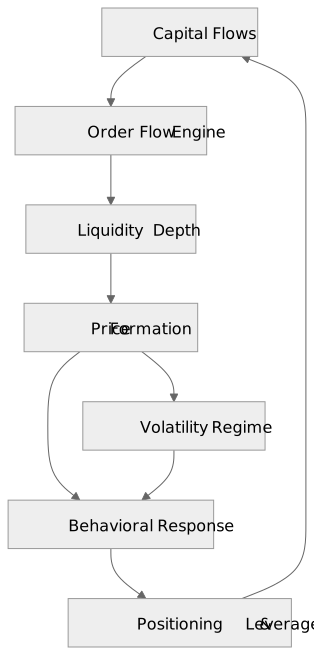
This diagram models the stock market as a constraint-based state machine where price, liquidity, and volatility regulate participant behavior.
The system does not “discover truth”; it processes order flow under structural constraints and outputs behavioral signals that shape future inputs.
The architecture separates:
Capital Inputs
Processing Layer (Microstructure)
Behavioral Outputs
Feedback Reinforcement
Capital enters the system as flow.
Order flow interacts with liquidity depth.
Price emerges from microstructure interaction.
Behavioral responses (fear, greed, mandates) alter positioning.
Positioning feeds back into capital flow.
Volatility represents regime transitions in system state.
This models the market as a closed-loop behavioral regulation system.
IF-D2 | v1.0 | 2026
This diagram illustrates how large institutional pools (pension funds, ETFs, sovereign funds) create structural flow pressure independent of firm-level fundamentals.
It models capital concentration as gravitational bias within the system.
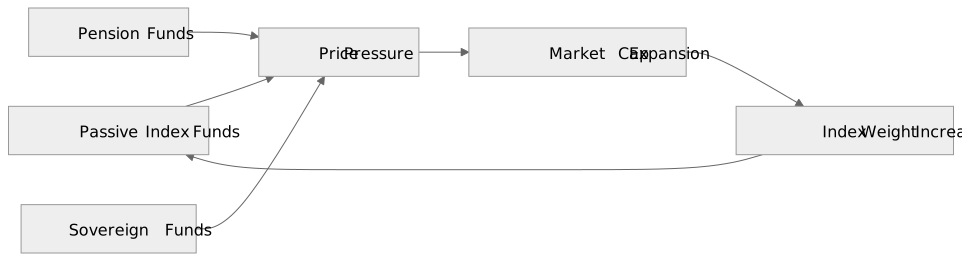
Passive capital concentrates into weighted assets.
Price appreciation increases index weighting.
Increased weighting attracts additional passive flow.
This creates a reinforcing loop.
This does not eliminate price discovery but alters elasticity and response sensitivity.
IF-D3 | v1.0 | 2026
This diagram models modern markets as a multi-agent cybernetic ecosystem composed of:
Human traders
Algorithmic agents
Institutional mandates
Regulatory stabilizers
Feedback loops determine regime stability or transition.
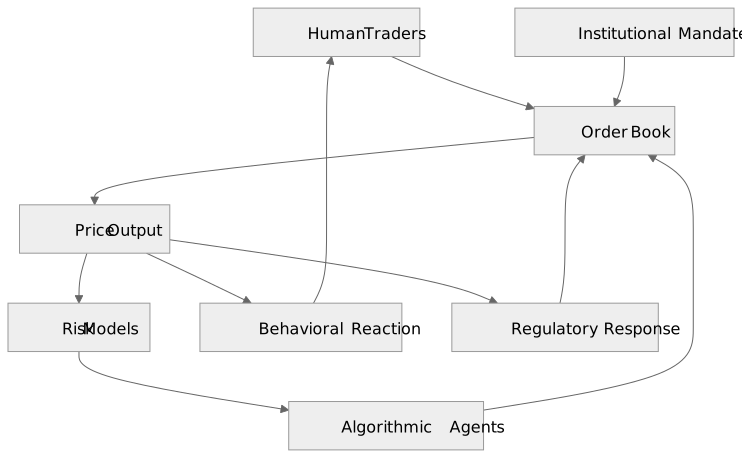
Algorithms adapt to price.
Humans react to price.
Risk models adjust algorithmic deployment.
Regulators intervene under stress.
Feedback loops determine stability.
Regime shifts occur when feedback amplification exceeds damping mechanisms.
IF-D4 | v1.0 | 2026
This state-machine model represents market regimes as transitions driven by liquidity and leverage conditions.
States:
Accumulation
Expansion
Distribution
Compression
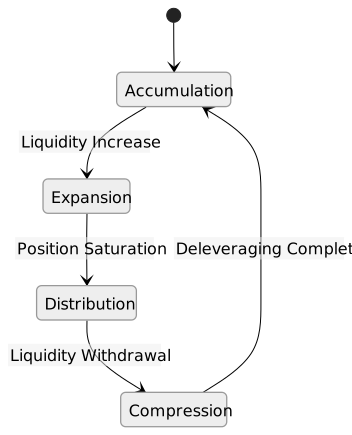
Leverage increases fragility.
Liquidity shocks widen spreads.
Forced selling transfers capital.
System resets with altered distribution.
Alignment with:
Market Microstructure Theory
Behavioral Finance
Complexity Economics
System Dynamics
Position of IF:
Systems-level integrative framing
Not replacement of economic theory
Structural visualization layer
IF-MKT-A1 | v1.0 | 2026
This framework operates under the following structural assumptions:
Price formation is primarily driven by order flow interacting with liquidity depth.
Market participants operate under incentive constraints (capital mandates, leverage limits, regulatory boundaries).
Liquidity is not constant; it expands and contracts across regimes.
Agents are not fully independent; synchronization effects occur via shared information channels.
Narrative intensity can influence trading velocity and liquidity demand.
Institutional capital pools exert measurable directional flow pressure.
Financial markets are embedded within monetary and regulatory frameworks.
Liquidity injections and policy interventions alter risk tolerance and leverage.
Regime shifts correspond to measurable changes in volatility, spread, and participation.
This model does not assume markets are centrally controlled.
It does not deny the role of fundamental valuation.
It does not assert deterministic predictability.
The framework models structure, not intent.
IF-MKT-S1 | v1.0 | 2026
The following variables determine robustness of the behavioral-constraint model:
Spread width
Order book depth
Market maker inventory exposure
ETF creation/redemption flows
Test:
Measure whether volatility regime shifts correlate with measurable liquidity contraction thresholds.
Passive fund net inflows/outflows
Institutional allocation cycles
Sector concentration ratios
Test:
Assess price elasticity relative to net passive flow intensity.
Margin debt levels
Derivatives open interest
Implied volatility term structure
Test:
Model nonlinear increases in crash probability as leverage-to-liquidity ratios rise.
News volume spikes
Social media sentiment velocity
Earnings surprise clustering
Test:
Measure whether synchronized narrative intensity precedes volatility expansion.
This section defines falsifiability conditions.
If correlations fail to replicate, the model weakens.
IF-MKT-C1 | v1.0 | 2026
| Model | Core View | Strength | Limitation |
|---|---|---|---|
| Efficient Market Hypothesis | Price reflects all available information | Elegant, mathematically tractable | Assumes agent independence |
| Behavioral Finance | Cognitive biases drive mispricing | Empirically rich | Often descriptive, not structural |
| Market Microstructure | Order flow drives price | Mechanically precise | Narrow scope |
| Complexity Economics | Markets as adaptive systems | Captures feedback loops | Less operationalized |
| IF Behavioral Constraint Model | Markets as feedback-regulated behavioral infrastructure | Integrates flow, incentives, synchronization | Requires empirical validation |
IF does not replace:
Microstructure theory
Behavioral finance
Institutional economics
It integrates them into a constraint-feedback architecture that:
Explains regime transitions
Models power asymmetry
Identifies redistribution mechanics
Frames volatility as structural event
This framework treats the stock market as a distributed regulatory system operating through numerical signals.
It does not moralize market behavior.
It models structural interactions between capital flow, incentives, and feedback dynamics.
Its validity depends on measurable replication across liquidity cycles and volatility regimes.
MC–SA–IF is not an alternative economic theory; it is a mechanical framework for understanding how incentive structures, liquidity architecture, information flow, and regulatory design shape market behavior.
It:
Maps cleanly onto existing research in market microstructure, behavioral finance, game theory, institutional economics, and system dynamics.
Treats markets as functional constraint systems rather than moral or ideological constructs — enabling measurable, protocol-based analysis of flows, regime shifts, and structural stress.
Provides a unifying operational layer that explains cross-market behavioral convergence without requiring shared beliefs, narratives, or political assumptions.
Integrates liquidity mechanics, leverage dynamics, mandate constraints, narrative synchronization, and feedback loops into a single structural model of market function.
Clarifies how price, volatility, and participation interact as regulatory signals within capital systems.
If your work touches price formation, capital allocation, liquidity modeling, behavioral synchronization, or financial stability, you are already engaging the mechanics this framework formalizes.
Does the work stand—does it obey the rules, does it violate the rules, or does it work?
Hopie Prophecy Stone & Methodology Entoptic Link & Methodology
Psychology - For more - Somatic Neuroscience
For collaboration, critique, or formal debate:
leadauditor@mc-sa-if.com